You can see I have updated the look and layout of the blog! I think it is easier to read and I hope you like it!
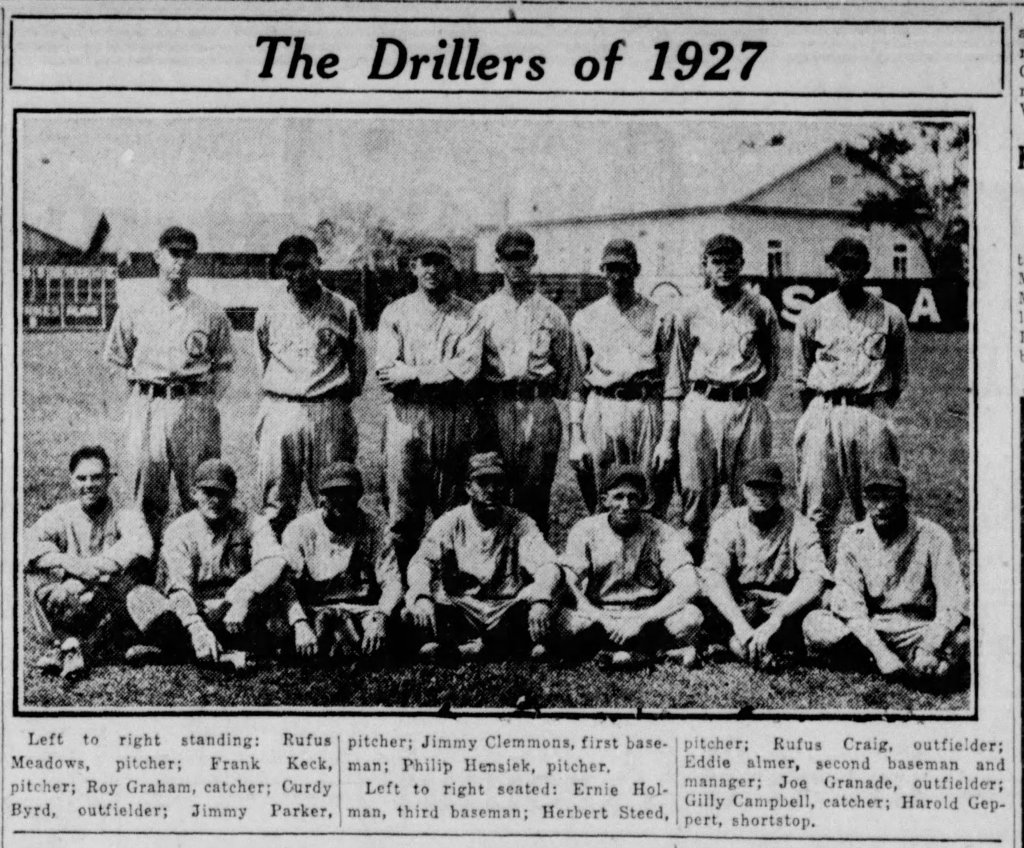
This was published in the News-Star on November 21, 1927. It is a very detailed look at the different Baseball teams and players in Monroe.
Monroe Baseball History Extends Back into ’90’s
Fans Have Always Been Much Interested in Diamond Sport.
Monroe is one of the oldest sporting towns in the state of Louisiana and has long been known for its interest in the many different modes of sport entertainment. There is hardly a southern outdoor or indoor sport in which the people of Monroe and vicinity are not well versed.
Probably the oldest form of sport that the people of Monroe and Ouachita parish took active part in is the game of baseball. Monroe athletes took to the game with a bang and by 1890 had one of the fastest town teams in this territory.
Slow Transportation
Although in those days the slow transportation facilities prevented any long trips frequently, the local ball nine was champion of Northeast Louisiana. The squad was composed of men about town who were holding down positions and playing ball when they could find a few moments to spare.
The park in those olden days was located where the Illinois Central shops are now [Next to the Old City Cemetery]. Two players of that time who still remain in the memories of those supporters of the game and who are still living are George Muir, first baseman, and George Volman, catcher. This pair of ball players, old timers contend, could compare favorably with the present day stars. The scene of the park was later on the corner of Washington and Seventh streets where the home of Charles Guerriero now stands [617 Washington Street]. It remained there for two years before moving across the street to the corner of Washington and Sixth streets where now stands the home of Louis Guerriero [214 N. 6th Street].
Stars of Old Days
Stars of the era that included the teams of 1899 and 1900 were Bob Simon, now living in the city, Jones and “Pug” Cloud, the latter evidently a star of the brightest sort as the old timers have great respect for the ability of this outfielder.
In 1903 a number of local sportsmen headed by H.R. Speed organized and bought a franchise from the Cotton States League. When the team entered organized baseball they moved the park to where the Dreamland theatre now stands [911 DeSiard Street].
In the original Cotton States loop were: Monroe, Pine Bluff, Greenville, Baton Rouge, Vicksburg and Natchez. The league finished the seasons of 1903 and 1904, but yellow fever brought it to a close in 1904 when that dread disease swept Louisiana, taking many of its ablest men.
Then in 1907 baseball was revived in the city when Monroe entered the Gulf Coast League, composed of teams from Lake Charles, Opelousas, Lafayette, Alexandria, Orange, Texas, and Monroe. The first manager of Monroe in the Cotton States League was Charley Hunt and T.L. Morris was president of the club. Crowder acted as president of the Cotton States League.
Dougherty ReCalled
One of the remembered incidents of the early life of professional baseball in Monroe was in 1903 when Tom Dougherty, an outfielder, came in to the hurling mound and hurled an eighteen inning scoreless game against the Baton Rouge team. Dougherty later went to the Atlanta club of the Southern league and from there to Chicago and later he finished his career with the Milwaukee club.
Of the first semi-pro clubs around the city many of the well known men of Monroe today were active. Harry Prophit was first baseman on the town team during the season of 1900. In 1899 J.R. Petagna was manager and Charley Hartley the catcher.
Baseball came back to the city in 1912 when a City League was formed with M.G. Spaugh as the president of the organization. Practically every man or boy in monroe at that time with any athletic ability was pushed into service on one of the teams.
Semi-Pro Started
Again in 1916 a City League was formed as in 1919 but in 1920 semi-pro baseball opened in Monroe again with D. Aubrey Haas as manager. In 1922 Harry Prophit had charge of the baseball affairs. he turned them back over to D. Aubrey Haas for the seasons of 1922-23. Of the team in 1923 two of the Monroe players were sent to the major leagues. Ray Benge went to the Cleveland club of the American league and Harold Crump, an infielder, was with the New York Giants the next season, although not as a regular. Benge was a pitcher.
In 1924 organized baseball came back in full bloom and has been established on a sound basis by prominent business men of the city. The first season after their entry into the league for the second time found the local Drillers, as they had been named, fighting for first lace from the first to the last, leading the procession the majority of both halves of the split season, but being beaten out of the pennant by Hattiesburg during the last few days of both halves.
W.C. Feazel was responsible for the Monroe franchise in the league. he selected Bill Wise to manager the team, which he died until the end of the first half when “Pep” Ripperton, shortstop, took over the reigns with Wise continuing to play in the role of an outfielder.
Atkins Takes Helm
The next two season were failures as far as the club standing was concerned. Both halves found the team on the bottom or near the bottom. Wise and Trammel managed the team. In 1926 P.M. Atkins took over the reigns of the president and appointed Charley Carroll as pilot. After failing to make a good impression during the first half, Carroll resigned and Eddie Palmer was appointed to take over the managerial responsibilities of the Drillers. he finished the season out in good style, although he failed to win the pennant. In 192 the same team of Atkins and Palmer headed the Monroe team and for the first time brought home a winner when the first half of the split season was won by the Monroe combination. The Jackson club, winners of the second half, was successful in beating the Monroe team in the play-off series. Monroe won only one game of the series, a Sunday game at Forsythe park before 1,800 paid admissions.
During the last four years the local baseball association has been exceedingly fortunate in selling players to higher leagues. In 1924 Tom Oliver was sold to Shreveport of the Texas League for $1,000. The next season found more going to higher company. J.P. Cook, pitcher, was sold to Pittsburgh of the National League for $4,000. Morris, infielder, was sold to Chattanooga for $750. Sam West later went to the Southern league after Judge Landis had awarded him to the Longview club of the East Texas League.
In 1926 the biggest sale of the year was the trade that sent George Ferrell, outfielder, to Memphis for Syd Hensiek, along with a large sum of money. Dale Adams, catcher, and Jimmy Clemmons, first baseman, were sold to Fort Worth of the Texas loop, but both were returned for further seasoning.
In 1927 more players than ever before were sold to leagues of higher classification. Syd Hensiek, pitcher, was sold to the Chicago White Sox for $4,000, Frank Keck, pitcher, to Ft. Worth for $1,55; Gilly Campbell, catcher, to Shreveport for two players and sum of money. Clemmons, first baseman, to Fort Worth for $3,000. Steed, pitcher, to Shreveport for $1,000.
Prospects for another winning team in 1928 are very bright, President P.M. Atkins believes.
By the way, the earliest mention of baseball in Monroe was found in the August 12, 1871 Ouachita Telegraph. It is kinda funny!
The base-ball infection has reached our city, and we have two clubs in training. We witnessed portion of a game a few days ago, and came away disappointed at not seeing some one’s shins cracked, or teeth knocked loose.
 Ouachita Parish History Tidbits
Leave a comment